
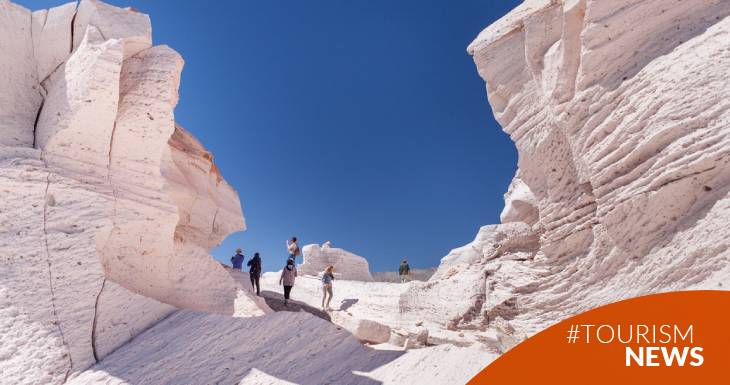
The Pumice Stone Field is a unique natural gem in the world and an unmissable destination for lovers of adventure, geology, and ecotourism—just the beginning of an unforgettable journey through one of Argentina’s most fascinating regions.
Covering more than 300 km², this vast field is made up of irregular blocks of pumice stone that resemble gigantic sculptures, scattered across the land by a massive volcanic explosion thousands of years ago. Forget the typical travel postcards: when you arrive at the Pumice Stone Field, it feels as if you’ve been transported to another planet.
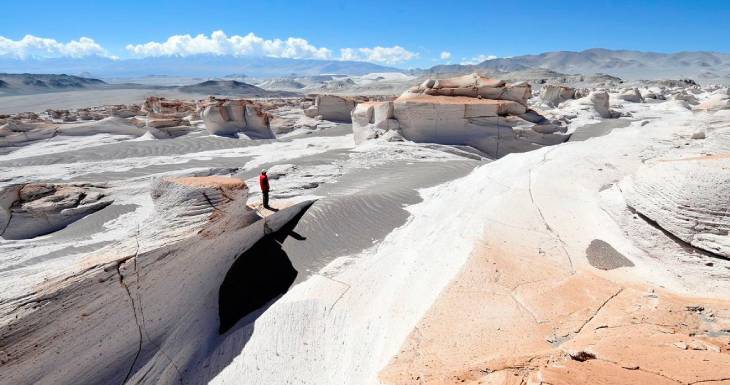
And that sensation is no coincidence. This extraordinary landscape was formed when volcanic lava cooled abruptly, trapping gas bubbles and creating a light, porous stone. Over thousands of years, the constant wind and the desert's extreme dryness sculpted whimsical shapes that today stretch across tens of thousands of protected hectares. Geological studies indicate that the entire field formed about 100,000 years ago, following eruptions from the nearby Blanco and Robledo volcanoes, both considered tourist attractions. Over time, erosion shaped these ancient rocks into the striking and almost hypnotic landscape seen today.
It’s not sand, and it’s not clay—it’s lightweight rock that can float on water. When you walk across it, it produces a crunchy texture beneath your feet. The scenery changes dramatically with the light: at sunrise it shines like silver, at midday it becomes an almost blinding white, and at sunset it casts golden shadows that seem straight out of a science-fiction movie.
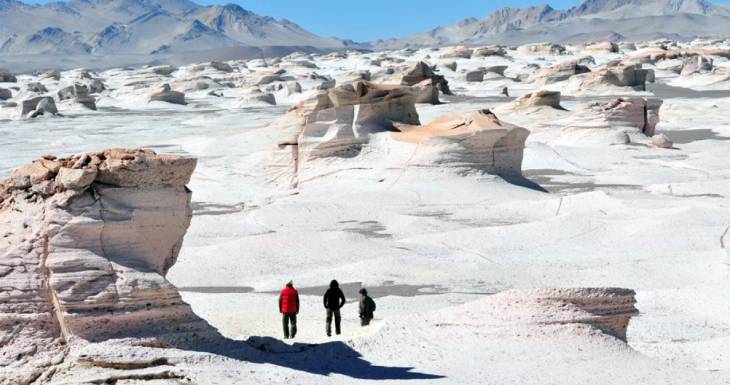
Since 2012, the area has been a protected natural reserve. Extracting material is prohibited, as is driving vehicles inside the field, to preserve its unique landscape and prevent environmental damage.
Many travelers describe the experience as walking over “petrified clouds”—and they’re not exaggerating. The lightness of the stone makes every step sound almost surreal.
And when night falls, the landscape doesn’t fade—it transforms. The combination of altitude, dry air, and the complete absence of light pollution turns the Pumice Stone Field into a natural astronomical observation point. The sky becomes the true protagonist, with the Milky Way visible to the naked eye, sharp constellations, and a depth rarely seen even in remote nature destinations. For many visitors, the nighttime experience is just as breathtaking as the daytime landscape.
A Route Through Volcanoes, Salt Flats, and Oases: A Destination for the Senses
Argentina’s Northwest (NOA)—and Catamarca Province in particular—is not a place you visit just to take a photo and leave. It’s a destination that awakens curiosity, clears the mind, and offers landscapes where desert, altitude, history, and culture blend into the perfect setting for explorers.
From the lunar-like terrain of the Pumice Stone Field to the towering peaks of the Andes—passing by lagoons, salt flats, legendary roads, and soulful villages—every kilometer reveals something new.
The Pumice Stone Field lies about 330 km from San Fernando del Valle de Catamarca. It can be accessed from different points in the region, such as El Peñón, Antofagasta de la Sierra, or Fiambalá, though in all cases the final stretch is along dirt roads. The journey itself is an experience: arid valleys, shimmering mountain ranges, and a silence broken only by the wind.
Reaching the site is recommended in a 4x4 vehicle, preferably with a local guide, due to the challenging terrain and the lack of signage, connectivity, and services along much of the route.
It’s also important to note that the field sits at over 3,000 meters above sea level, with some areas reaching even higher altitudes. Atmospheric pressure is lower, and oxygen levels are reduced, which can cause discomfort if proper precautions are not taken.
For that reason, visitors are advised to walk slowly, avoid intense physical exertion, stay well hydrated, and allow the body to adapt gradually to the altitude. It is also recommended to visit during milder seasons—spring or autumn—and to bring plenty of water, sunscreen, and a hat: the desert sun can be unforgiving.
But Catamarca is much more than a surprising landscape—it is a sequence of settings that change with every kilometer.
Some must-visit places include:
- Cuesta del Portezuelo A scenic road that climbs from the valley to the heights, with curves that look like painted landscapes—ideal for lovers of panoramic routes.
- Ancasti Valley A landscape of ravines, reddish hills, and absolute tranquility, perfect for those seeking rest with endless views.
- The Six-Thousanders (Andes Mountain Range) Spectacular peaks rising above 6,000 meters, ideal for trekking, epic photos, or simply contemplating the majesty of the Andes.
- Dams and Lagoons El Jumeal Dam, La Cañada, Laguna Verde… bodies of water that contrast with the desert and offer spaces for picnics, kayaking, or simply relaxing under the sun.
- Belén and the Adobe Route Quiet towns where time seems to move more slowly, with traditional architecture and unique handicrafts.
- Fiambalá and its Hot Springs Natural thermal baths in the middle of the desert, with warm waters ideal for relaxing after days of adventure.
To these landscapes are added other lesser-known but equally striking natural spots, such as the large high-altitude salt flats, Andean lagoons, and nature reserves where typical Puna wildlife can be observed.
And among so much scenery, when it comes time to taste its typical dishes, you cannot miss the regional barbecue with juicy cuts grilled under the sun, humitas and tamales with that homemade flavor that only northern Argentina can offer, and a variety of artisanal high-altitude wines.
Catamarca is no longer a hidden gem. Now it is a place worth exploring and experiencing. The Pumice Stone Field (El Campo de Piedra Pómez) is only the gateway to a universe of sand, rock, history, and endless possibilities.